
Reading a Technical Data Sheet (TDS)for Vinyl Flooring requires cross-referencing industry-standard ASTM or ISO test results against your specific project requirements to ensure safety and long-term durability. Many B2B flooring distributors and contractors struggle to interpret the complex technical jargon and varying standards found in manufacturer documents. Misreading a single specification can lead to catastrophic project failures, denied warranty claims, and significant financial losses if the selected product cannot withstand its environment. This comprehensive guide simplifies the Technical Data Sheet (TDS)for Vinyl Flooring , teaching you exactly how to identify high-quality specifications and verify performance like an industry expert.
What is a Technical Data Sheet (TDS) for Vinyl Flooring?
Understanding every Technical Data Sheet (TDS)for Vinyl Flooring starts with identifying the core product composition and intended application categories. This document serves as the “blueprint” of a floor, providing verified laboratory data on how the material will behave under stress.
Defining the Document Scope
The TDS outlines the physical properties and performance metrics of a specific flooring product line. It serves as a legal verification of quality that bridges the gap between raw manufacturing and architectural requirements.
Look at this:
- Material Composition: PVC content, binders, and fillers.
- Dimensional Specs: Thickness, width, and length.
- Safety Ratings: Fire, slip, and smoke density.
Here is the kicker: without a formal TDS, you are essentially gambling on the integrity of your entire project.
Why B2B Distributors Need Accurate Data
For distributors, the TDS is the primary tool used to compare competitive offerings and justify price points. It ensures that the batch being imported meets the rigorous standards of the local market.
Consider these factors:
- Warranty Support: Verification for insurance claims.
- Client Trust: Providing evidence-based recommendations.
- Compliance: Meeting regional building codes.
The point is, a professional distributor never relies on a brochure when a TDS is available.
Key Takeaway: The TDS is a foundational document for quality control and legal compliance in professional flooring procurement.
| Core Component | Importance for Quality Control |
|---|---|
| Material Composition | Determines strength and chemical resistance |
| Dimensions | Affects installation precision and waste |
| Safety Ratings | Ensures legal compliance in public spaces |
Analysis of the core components reveals that technical data is the only objective way to verify product performance prior to installation.
How Does Wear Layer Thickness Impact Durability?
Comparing a Technical Data Sheet (TDS)for Vinyl Flooring requires a deep dive into the wear layer specifications to ensure long-term surface protection. Thicker wear layers provide significantly higher abrasion resistance, which is critical for extending the lifespan of the floor in heavy-traffic environments.
Understanding Mils vs. Millimeters
Many professionals confuse “mils” with millimeters, but they are distinct units of measurement that indicate the top protective coating’s depth. One mil is 1/1000th of an inch, while 1.0mm is approximately 40 mils.
Think about this:
- Residential standard: 12 mil (0.3mm).
- Light commercial: 20 mil (0.5mm).
- Heavy commercial: 28 mil (0.7mm).
Here is the truth: selecting a 12 mil floor for a hospital corridor is a recipe for surface failure within months.
Impact of UV Coating on Abrasion Resistance
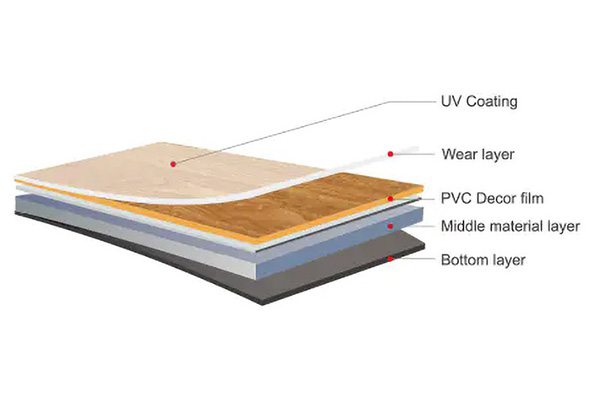
The presence of a high-quality UV coating or ceramic bead finish on the TDS indicates enhanced resistance to micro-scratches. This secondary layer works in tandem with the wear layer to maintain the aesthetic integrity of the design film.
Check this out:
- Anti-stain properties: Protection against chemicals and spills.
- Color fastness: Resistance to fading from sunlight.
- Surface Texture: Depth of embossing and slip resistance.
The bottom line is that the wear layer is the most influential factor in your floor’s maintenance cycle.
Key Takeaway: Always match the wear layer thickness to the intended traffic level to prevent premature floor degradation.
| Wear Layer (mm) | Traffic Rating | Typical Use Case |
|---|---|---|
| 0.3mm | Residential | Bedrooms and home offices |
| 0.5mm | Commercial | Retail shops and hotel rooms |
| 0.7mm | Heavy Commercial | Airports and high-traffic malls |
By evaluating wear layer thickness, professionals can accurately predict the maintenance requirements and longevity of the flooring surface.
Why is Dimensional Stability Essential for Vinyl?
Looking at a Technical Data Sheet (TDS)for Vinyl Flooring helps you verify if the planks will warp or buckle under extreme temperature changes. Dimensional stability measures the material’s ability to retain its original shape when exposed to heat and humidity.
The ISO 23999 Testing Standard Explained
The gold standard for stability testing involves exposing samples to 80°C for six hours to measure linear change. High-quality vinyl will show a minimal percentage of change, usually below 0.15%.
Look at this:
- Expansion: Growth in length under heat.
- Contraction: Shrinkage as the temperature cools.
- Curling: Lifting of the edges or corners.
The real secret is that low-quality products often lack these specific test results entirely.
Managing Thermal Expansion in Rigid Cores
Rigid core products like SPC excel in dimensional stability due to their limestone-based composition. This allows for larger installation spans without the need for frequent transition strips.
Here is the kicker:
- Click integrity: Stable planks protect the locking system.
- Joint failure: Stability prevents gaps from opening.
- Subfloor tolerance: Better handling of minor imperfections.
Simply put, stability is what keeps your floor looking seamless over years of seasonal shifts.
Key Takeaway: High dimensional stability is non-negotiable for large-scale commercial projects or areas with floor-to-ceiling windows.
| Stability Metric | Acceptable Limit | Performance Result |
|---|---|---|
| Linear Change | ≤ 0.12% | Premium stability; no buckling |
| Curling Change | ≤ 2.0mm | Flat edges even after heat exposure |
| Residual Indentation | ≤ 0.10mm | High resistance to heavy furniture |
This data demonstrates why rigid core flooring is the preferred choice for environments with significant thermal fluctuations.
Which Fire Ratings Should You Look for in a TDS?
Every Technical Data Sheet (TDS)for Vinyl Flooring must include safety data regarding fire resistance and smoke development to meet strict building codes. The most common verified standard for the North American market is ASTM E648, while European projects look for EN 13501-1.
ASTM E648 Critical Radiant Flux Tests
This test measures the minimum energy required to sustain flame propagation on the floor’s surface. A Class I rating indicates a critical radiant flux of 0.45 W/cm² or higher, which is required for most commercial corridors.
Here is the deal:
- Class I: High fire resistance for egress paths.
- Class II: Moderate resistance for residential units.
- Flame Spread: How fast the fire moves across the surface.
The kicker is that failing this requirement can lead to a project being shut down by the fire marshal.
European EN 13501-1 Classifications
For global projects, the Bfl-s1 rating is the target for high-performance vinyl. This classification addresses both the reaction to fire and the volume of smoke produced.
Pay attention to this:
- Bfl: Refers to the flame spread.
- s1: Refers to low smoke production.
- Safety: Vital for hospitals and kindergartens.
You simply cannot overlook these safety metrics when choosing a supplier for public spaces.
Key Takeaway: Fire ratings are legal requirements; always verify that the TDS lists a specific ASTM or EN classification.
| Fire Standard | Rating | Application |
|---|---|---|
| ASTM E648 | Class 1 (≥ 0.45) | Commercial corridors and stairs |
| EN 13501-1 | Bfl-s1 | High-occupancy public buildings |
| GB 8624 | B1 | Non-flammable commercial grade |
Analyzing fire safety ratings shows that premium vinyl flooring provides essential protection in emergency egress situations.
How Do You Interpret Overall Thickness and Density?
The structural depth noted on a Technical Data Sheet (TDS)for Vinyl Flooring directly influences the floor’s feel and impact resistance. While overall thickness adds comfort, the density of the core determines how well the floor resists permanent indentations from furniture.
Total Thickness vs. Structural Integrity
While a thicker floor might seem more durable, it is actually the ratio of core material to wear layer that matters. A 5mm floor with a dense SPC core is often superior to a 7mm floor with a foam-filled core.
Look at this:
- Standard SPC: 4mm to 6mm thickness.
- Standard LVT: 2mm to 3mm thickness.
- Transition: Thicker floors align better with existing tiles.
The real story here is that core density is the silent hero of floor longevity.
Impact of Integrated Underlayment (IXPE)
Many high-performance floors now include a pre-attached IXPE backing. This layer on the TDS isn’t just for comfort; it provides a significant moisture barrier and acoustic insulation.
Here is the kicker:
- Speed: Faster installation with no separate padding.
- Hygiene: Antimicrobial treatments in the foam.
- Leveling: Ability to bridge minor subfloor dips.
Think of the underlayment as the foundation that supports the entire plank structure.

Key Takeaway: Prioritize high-density core specifications over total thickness to ensure the floor resists heavy static loads.
| Core Type | Density (kg/m³) | Impact Resistance |
|---|---|---|
| Standard SPC | 1900 – 2100 | Excellent; resists dents |
| Flexible LVT | 1200 – 1400 | Moderate; better for comfort |
| WPC | 800 – 1000 | Lower; high sound insulation |
A comparison of core densities highlights that SPC offers the highest level of protection against heavy furniture and impact.
What Are the Standards for Slip and Chemical Resistance?
Checking a Technical Data Sheet (TDS)for Vinyl Flooring ensures the surface is safe for high-traffic environments prone to spills. Slip resistance is typically measured by the R-value or the dynamic coefficient of friction (DCOF).
R-Values and Pendulum Slip Test Results
The R-value (R9 to R13) indicates the angle at which a person begins to slip on an oil-covered surface. For most commercial applications, an R10 rating is the baseline for safety in areas like lobbies or restrooms.
Look at this:
- R9: Low friction; dry areas only.
- R10: Standard commercial; wet-area safe.
- R11: Industrial; high-slip risk zones.
The kicker is that selecting the wrong slip rating can open your business to significant liability lawsuits.
Resistance to Industrial Cleaning Chemicals
In healthcare settings, the TDS must prove resistance to harsh sanitizers via the ASTM F925 test. This ensures the floor won’t discolor or degrade when exposed to alcohol-based cleaners.
Check this:
- Stain resistance: Protection against betadine and dyes.
- Cleanability: How easily the surface releases dirt.
- Surface finish: Matte finishes hide chemical etching better.
If the TDS doesn’t mention ASTM F925, you should proceed with extreme caution for medical projects.
Key Takeaway: Slip and chemical resistance ratings are vital for liability management in hospitality and healthcare sectors.
| Rating Category | Standard | Ideal Result |
|---|---|---|
| Slip Resistance | DIN 51130 | R10 or higher |
| Chemical Resistance | ASTM F925 | No change / Slight change |
| Stain Resistance | ISO 26987 | Grade 0 (No effect) |
By verifying these specific safety standards, distributors can ensure they are providing products fit for demanding public use.
Why Do ASTM and ISO Standards Matter Most?
A professional Technical Data Sheet (TDS)for Vinyl Flooring should reference globally recognized ASTM and ISO tests to prove product quality. These standards provide a universal language that allows you to compare a manufacturer in China with one in Europe accurately.
Comparing North American and Global Specs
ASTM (American Society for Testing and Materials) is the primary reference in the US, while ISO (International Organization for Standardization) is global. A robust TDS will often list both to demonstrate international versatility.
Think about this:
- ASTM F1700: The baseline for solid vinyl tile.
- ISO 10582: Global spec for resilient floor coverings.
- Third-party labs: Look for SGS or Intertek logos.
Here is the truth: any “specification” without a corresponding standard number is just a marketing claim.
Verification via Third-Party Lab Reports
Always ask for the full lab report that backs up the TDS data. Manufacturers committed to quality will readily provide these documents to prove their claims regarding wear or stability.
Here is the kicker:
- Date: Ensure the test was performed recently.
- Batch: Verify the test matches current production.
- Authenticity: Cross-check report numbers with the lab.
The bottom line is that third-party verification is your only shield against low-quality “shoddy” materials.
Key Takeaway: Never accept performance claims that are not backed by a cited ASTM or ISO test standard.
| Organization | Standard Number | What it Measures |
|---|---|---|
| ASTM | F410 | Wear layer thickness |
| ISO | 23999 | Dimensional stability |
| ASTM | F1914 | Residual indentation |
International standards act as a quality benchmark, ensuring that B2B buyers receive consistent and reliable products.
How Does Sound Insulation Influence Product Selection?
Evaluating a Technical Data Sheet (TDS)for Vinyl Flooring is the only way to confirm if the product provides adequate noise reduction between floors. Acoustic performance is measured using Impact Insulation Class (IIC) and Sound Transmission Class (STC) ratings.
Understanding IIC and STC Acoustic Ratings
IIC measures how well the floor absorbs impact noise like footsteps, while STC measures how well it blocks airborne sound like voices. For multi-family housing, most building codes require a minimum IIC rating of 50.
Look at this:
- IIC 50: Basic code compliance.
- IIC 60: High-end acoustic luxury.
- STC: Critical for office privacy.
Here is the deal: without high acoustic ratings, your high-end apartment project will feel like a noisy warehouse.
The Role of Backing in Multi-Story Projects
The integrated IXPE backing shown on a high-quality TDS can improve IIC ratings by up to 20 decibels. This eliminates the need for expensive secondary acoustic underlayments.
Check this out:
- Vibration damping: Softening the energy of footfalls.
- Noise decay: How fast sound dies out in the room.
- Subfloor isolation: Decoupling the floor from the structure.
Selecting a floor with pre-attached backing is the most cost-effective way to meet acoustic mandates.
Key Takeaway: Acoustic ratings are essential for apartments and offices; prioritize floors with verified IIC results above 55.
| Sound Metric | Target Level (dB) | Project Type |
|---|---|---|
| IIC | 55 – 72 | Multi-family housing |
| STC | 50 – 65 | Private offices |
| Footfall Sound | < 18 dB reduction | Commercial workspaces |
Acoustic data provided in the TDS is crucial for selecting materials that enhance the comfort and privacy of indoor spaces.
What Environmental Certifications Should You Verify?
Quality indoor air starts with the environmental data provided on a Technical Data Sheet (TDS)for Vinyl Flooring regarding VOC emissions. As sustainability becomes a market requirement, these certifications have moved from “nice-to-have” to mandatory.
Low VOC and FloorScore Certifications
FloorScore is the most recognized certification for resilient flooring, ensuring that VOC emissions stay below strict thresholds. This certification is often required for LEED credits in green building projects.
Look at this:
- Indoor Air Quality: Reducing chemical odors.
- Health: Safe for schools and hospitals.
- Formaldehyde: Ensuring zero-emission cores.
Here is the kicker: high VOC floors can cause “sick building syndrome” and lead to expensive liability.
Recycled Content and Sustainability Claims
A transparent TDS will list the percentage of post-consumer or pre-consumer recycled content. This data supports corporate social responsibility (CSR) goals for large contractors.
Consider this:
- Phthalate-free: Removing harmful plasticizers.
- Recyclability: Can the floor be reused later?
- Supply Chain: Ethical sourcing of raw materials.
You should always look for the FloorScore or CE logo as a baseline for environmental safety.
Key Takeaway: Environmental certifications protect end-user health and provide essential credits for green building projects.
| Certification | What it Verifies | Industry Standard |
|---|---|---|
| FloorScore | Low VOC emissions | SCS Global Services |
| REACH | Chemical safety (EU) | Regulation (EC) 1907 |
| CE | Safety and health compliance | European Union Standard |
Verifying environmental data ensures that the flooring material contributes to a healthy and sustainable indoor environment.
How Can You Spot Red Flags in a Vinyl Flooring TDS?
Never finalize a bulk order without auditing the Technical Data Sheet (TDS)for Vinyl Flooring for missing data or suspicious performance claims. A professional audit can save you from importing container-loads of substandard material.
Incomplete Data and Vague Performance Specs
A major red flag is a TDS that lists “Excellent” or “High Performance” without citing a specific ASTM or ISO test number. If the manufacturer cannot provide the standard they tested against, the data is likely fabricated.
Look at this:
- Missing test dates: Old data from defunct factories.
- Generic terms: Using “commercial grade” loosely.
- No core density: Hiding a low-quality limestone ratio.
The kicker is that if it looks too good to be true, it probably is.
Mismatched Core and Wear Layer Ratios
Watch out for “Frankenstein” products, such as a 7mm plank with only a 0.3mm wear layer. This is a common tactic to make a cheap floor feel high-end while sacrificing actual durability.
Here is the kicker:
- Density check: Heavy planks aren’t always high density.
- Coating quality: Missing mentions of UV or Ceramic beads.
- Locking system: Vague mentions of “easy click” without brand names.
Always cross-reference the TDS against physical samples to ensure the data matches reality.
Key Takeaway: Audit every TDS for missing standards and illogical spec ratios before committing to a purchase.
| Red Flag | Reason for Concern | Expert Recommendation |
|---|---|---|
| Missing ASTM/ISO | Data cannot be verified | Request full lab reports |
| Low density / High thickness | Structural instability | Demand SPC density specs |
| No fire rating | Legal safety hazard | Do not purchase for commercial |
By identifying these common red flags, B2B professionals can avoid high-risk suppliers and protect their project margins.
Master Your Procurement Strategy Today
Interpretation of a TDS is the difference between an industry leader and a novice. By understanding wear layers, stability standards, and fire ratings, you ensure that every square meter of flooring you install is a testament to quality. If you are ready to source high-performance flooring backed by verified technical data, contact us to discuss your next project.
FAQ
- Can I trust a TDS that doesn’t list specific ASTM or ISO test numbers? No, you should never trust unverified data. Genuine manufacturers always cite the specific international standards used to validate their performance claims.
- What’s the best way to verify that a manufacturer’s TDS is actually accurate? Request the original third-party lab reports from agencies like SGS or Intertek. Cross-reference the report number on the lab’s official website to ensure it hasn’t been tampered with.
- How do I know if a wear layer is sufficient for a high-traffic hospital corridor? Look for a wear layer of at least 0.7mm (28 mil) and an AC5 rating. This ensures the surface can withstand the constant abrasion of heavy rolling loads and foot traffic.
- Can I use a TDS to compare different vinyl core types like SPC and LVT? Yes, simply compare the density and dimensional stability metrics. SPC will typically show much higher density and lower thermal expansion percentages than traditional flexible LVT.
- How do I know if the fire rating on a TDS is valid for my local building code? Compare the listed rating (like ASTM E648 Class 1) against your regional NFPA or IBC requirements. If the TDS only lists foreign standards, request a conversion or a local test report.