

Sourcing high-quality flooring can be a significant challenge for global distributors facing inconsistent batches and shipping delays. These disruptions not only hurt your bottom line but also damage the trust your clients place in your brand. By understanding the inner workings of an spc floor production line , you can better evaluate manufacturing quality and ensure you are partnering with a reliable factory.
What makes an spc floor production line efficient?
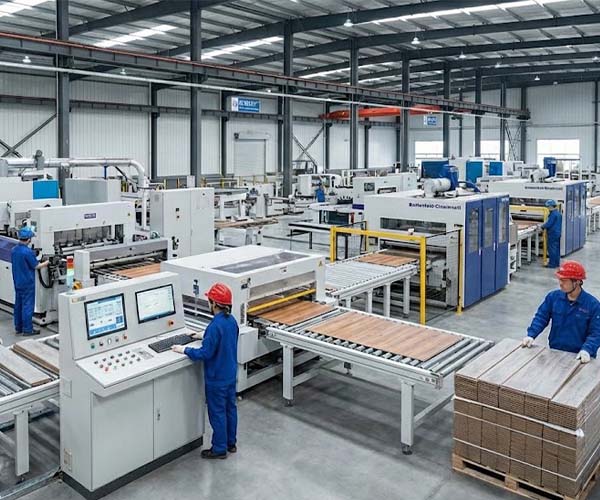
Efficiency in a professional spc floor production line comes from high levels of automation and integrated PLC control systems. These systems manage the entire flow from raw powder to finished planks without human error.
The Role of Full Automation
You will notice that modern factories use robot arms and automated conveyors to move materials between stations. This reduces labor costs while significantly increasing the daily output for large-scale projects.
Think about it:
- Reduced manual handling errors.
- Continuous 24/7 operation capabilities.
- Real-time data monitoring for yield.
High-Capacity Output Standards
You need a line that can produce thousands of square meters daily to keep up with global demand. High-speed extruders are the foundation of this scale, ensuring you never run out of stock.
The best part?
- Synchronized production stages.
- Minimized downtime between batches.
- Rapid scalability for OEM orders.
Precision Temperature Management
You must maintain exact thermal levels to prevent the core from becoming brittle or too soft. Automated sensors track heat every second to ensure the material remains within a 1-degree tolerance.
Here is the secret:
- Prevents chemical degradation of PVC.
- Ensures uniform density across the sheet.
- Optimizes energy consumption.
Key Takeaway: Automation and thermal precision are the primary drivers of manufacturing speed and product consistency.
| Feature | Impact | Benefit | |
|---|---|---|---|
| PLC Systems | Process Control | Low Defect Rate | |
| High-Speed Extruders | Volume | Market Security | |
| Thermal Sensors | Core Quality | Structural Integrity |
The integration of smart technology allows for a streamlined workflow that eliminates the bottlenecks typical of older manufacturing methods.
Which raw materials enter the spc floor production line?
The materials entering a professional spc floor production line consist of high-purity calcium carbonate, virgin PVC resin, and eco-friendly stabilizers. This specific blend creates the “Stone Plastic Composite” known for its extreme rigidity.
Sourcing Premium Calcium Carbonate
You want a core that provides maximum stability, which starts with finely ground limestone. This mineral filler gives the floor its stone-like strength and heat resistance.
But that is not all:
- Increases dimensional stability.
- Provides 100% fire resistance.
- Lowers the overall carbon footprint.
Utilizing Virgin PVC Resin
You should always prioritize virgin PVC over recycled materials to ensure safety and longevity. Virgin resins are free from heavy metals and provide a more reliable bond during extrusion.
Believe it or not:
- Zero formaldehyde emissions.
- Better impact resistance.
- Consistent color throughout the core.
Essential Non-Toxic Stabilizers
You need stabilizers to prevent the PVC from breaking down during the high-heat manufacturing process. We use calcium-zinc stabilizers to maintain an eco-friendly profile for your clients.
Let’s be honest:
- Protects the environment.
- Enhances UV resistance.
- Extends the floor’s lifespan.
Key Takeaway: Using high-purity virgin materials ensures the final product is both safe for indoor use and physically durable.
| Material | Primary Role | Result | |
|---|---|---|---|
| Limestone | Rigid Foundation | Heat Stability | |
| Virgin PVC | Binding Agent | Waterproofing | |
| Ca-Zn Stabilizer | Chemical Balance | Eco-Safety |
A clean material profile is the only way to meet strict international air quality standards like FloorScore or Greenguard.
How is mixing managed in an spc floor production line?
Mixing in an spc floor production line is managed through a two-stage process involving high-speed hot mixing followed by rapid cooling. This ensures the powder compound is perfectly homogenous before it hits the extruder.
High-Speed Hot Blending
You will find that the raw materials are heated to roughly 125°C to remove moisture and melt the stabilizers into the resin. This creates a uniform “dough” that is ready for shaping.
Keep this in mind:
- Eliminates air pockets in the core.
- Ensures stabilizers are fully active.
- Prepares the powder for smooth flow.
Rapid Cooling for Stability
You must quickly drop the temperature to about 55°C after the hot mix to prevent the material from clumping. This cold mixing stage preserves the chemical properties of the blend.
Wait, there’s more:
- Prevents pre-mature hardening.
- Increases material flow efficiency.
- Reduces waste from agglomeration.
Automated Metering Precision
You need exact ratios to maintain batch-to-batch consistency for your large distribution orders. Automated weighing systems ensure that every gram of limestone and PVC is accounted for.
Does it work?
- Guarantees 0.1% ratio accuracy.
- Removes human weighing errors.
- Supports custom formulation requests.
Key Takeaway: Precise mixing cycles prevent future structural issues like delamination or brittle edges in the finished planks.
| Mixing Phase | Temperature | Core Objective | |
|---|---|---|---|
| Hot Mixing | 125°C | Homogenization | |
| Cold Mixing | 55°C | Flow Stability | |
| Metering | Ambient | Ratio Accuracy |
Uniform blending is the “invisible” step that determines whether a floor will fail under heavy commercial traffic.
How does extrusion define the spc floor production line?
Extrusion defines the spc floor production line by forcing the molten compound through a flat T-die to create the rigid core sheet. This phase determines the thickness and density of every plank you sell.
Twin-Screw Extruder Performance
You rely on the high torque of twin-screw extruders to melt the dense stone-plastic blend efficiently. This machine is the powerhouse of the factory, dictating the daily square footage.
Simply put:
- Provides high-pressure output.
- Ensures deep material melting.
- Handles heavy mineral loads.
Four-Roll Calender Shaping
You will see the molten sheet pass through heavy rollers that press it to a precise thickness. This “calendering” process is what gives the SPC its signature flat and smooth surface.
Think about it:
- Accuracy within 0.05mm.
- Eliminates surface waves.
- Sets the base for lamination.
Integrated Cooling Brackets
You must cool the sheet gradually to prevent internal stresses that could lead to warping. Long cooling brackets allow the rigid core to set naturally before the cutting stage.
The best part?
- Retains dimensional memory.
- Ensures planks stay flat.
- Prepares the surface for UV.
Key Takeaway: The extrusion and calendering stage is the most critical phase for achieving thickness precision and structural density.
| Component | Function | Quality Impact | |
|---|---|---|---|
| Twin-Screw | Melting | Core Strength | |
| T-Die | Sheet Forming | Width Consistency | |
| Calender | Compression | Thickness Accuracy |
Advanced extrusion technology allows for the production of ultra-thin yet incredibly strong flooring that outlasts traditional vinyl.
How are visuals applied to an spc floor production line?
Visuals are applied to an spc floor production line using an online lamination process that bonds layers while the core is still hot. This “no-glue” method ensures the decorative film and wear layer become part of the core itself.
Online Heat Lamination
You benefit from the residual heat of the extrusion process, which fuses the layers together under pressure. This creates a permanent bond that is far superior to traditional cold-press methods.
Here is the secret:
- Eliminates the need for adhesives.
- Prevents layer peeling (delamination).
- Increases production speed significantly.
Aligning Decorative Film Patterns
You need the wood or stone patterns to be perfectly straight as they feed into the rollers. High-precision sensors monitor the film alignment to ensure your planks look realistic and high-end.
But that is not all:
- Supports HD print technology.
- Syncs textures with visuals.
- Reduces waste from misprints.
Application of the Wear Layer
You must apply a high-quality wear layer (usually 0.3mm to 0.7mm) to protect the floor from scratches. This clear layer is pressed simultaneously with the decor film for maximum efficiency.
Believe it or not:
- Protects the design from fading.
- Provides the AC3-AC5 rating.
- Enhances stain resistance.
Key Takeaway: Online lamination creates a fused, multi-layer structure that is 100% waterproof and resistant to peeling.
| Layer | Function | Standard Range | |
|---|---|---|---|
| Wear Layer | Scratch Defense | 0.3mm – 0.7mm | |
| Decor Film | Aesthetic Look | HD Wood/Stone | |
| Rigid Core | Support Structure | 4.0mm – 7.0mm |
By bonding layers during the core formation, we ensure the floor maintains its integrity even in high-moisture environments.
What role does UV coating play in the production line?
UV coating in an spc floor production line serves as the final protective barrier and surface treatment. This stage ensures the floor is ready for sunlight exposure and heavy daily maintenance.
Multi-Stage UV Curing
You will see the planks pass under intense ultraviolet lights that instantly harden the protective liquid. This creates a ceramic-reinforced surface that stands up to commercial scuffs.
Let’s be honest:
- Instant drying for fast packaging.
- Higher scratch resistance than PVC alone.
- Easier cleaning for end-users.
Stain and Slip Resistance
You need a surface that repels liquids and provides a safe grip for high-traffic areas. The UV layer contains additives that improve the floor’s slip rating to meet local building codes.
Keep this in mind:
- Repels oil and food stains.
- Provides a consistent matte finish.
- Meets P3/P4 slip standards.
Antibacterial Surface Treatments
You can request specialized UV coatings that inhibit the growth of bacteria and mold. This is a massive selling point for projects in hospitals, schools, or nurseries.
Wait, there’s more:
- Enhances indoor air hygiene.
- Reduces the need for harsh chemicals.
- Adds value to your private label.
Key Takeaway: UV coating is the final line of defense that guarantees colorfastness and long-term surface durability.
| Surface Feature | Benefit | Technical Goal | |
|---|---|---|---|
| UV Curing | Stain Shield | Surface Hardness | |
| Matte Finish | Aesthetic | Low Light Glare | |
| Anti-Scratch | Longevity | Wear Protection |
A high-quality UV treatment ensures that your customers’ floors look brand new for years, even in direct sunlight.
Why is tempering vital for an spc floor production line?
Tempering is vital for an spc floor production line because it removes the internal stresses created during high-temperature extrusion. This process involves passing the planks through hot and cold water baths to “set” their shape.
Hot Water Bath Stress Relief
You will see the planks submerged in hot water (80°C – 120°C) to allow the molecular structure to relax. This prevents the “curling” effect that often plagues low-quality SPC products.
Does it work?
- Equalizes internal core pressure.
- Prevents future edge lifting.
- Improves overall plank flatness.
Cold Water Setting Phase
You then pass the material through a cold bath (around 10°C) to lock the dimensions in place permanently. This “thermal shock” ensures the plank will not expand or contract in the field.
Simply put:
- Creates dimensional memory.
- Stabilizes the click-lock system.
- Hardens the core for milling.
Long-Term Dimensional Stability
You must provide a floor that can handle 60-degree temperature swings without buckling. Tempering is the specific manufacturing secret that allows SPC to be installed in large sunrooms.
Think about it:
- Reduces expansion gaps needed.
- Allows for larger installation spans.
- Minimizes post-install complaints.
Key Takeaway: The tempering process is the primary reason professional SPC flooring remains stable in extreme climates.
| Process | Temperature | Business Benefit | |
|---|---|---|---|
| Hot Tempering | 80°C+ | No Edge Warping | |
| Cold Setting | 10°C | Size Consistency | |
| Stabilization | Time-based | Zero Returns |
Planks that skip the tempering stage are prone to shrinking, leading to unsightly gaps that can ruin your brand’s reputation.
How is click-lock precision achieved in the line?
Precision click-lock profiles in a professional spc floor production line are achieved through high-speed milling with diamond-tipped tooling. This ensures a waterproof, gap-free fit for every installation.
High-Speed Slitting and Cutting
You start by cutting the large sheets into individual planks using automated sensors. These blades are accurate to the millimeter, ensuring that the length and width of every batch match.
The best part?
- Synchronized cutting patterns.
- Waste reduction through precision.
- Perfectly square plank corners.
Diamond-Tipped Milling Tools
You cannot use standard steel blades for SPC because the high stone content would dull them instantly. We use industrial diamonds to carve the tongue and groove profiles with micro-precision.
Here is the secret:
- Smooth edges for easy locking.
- High-tension click strength.
- Consistent profile geometry.
Automated Profile Inspection
You will find sensors at the end of the milling line that check the click dimensions in real-time. If a profile deviates by even 0.1mm, the machine stops to prevent defective stock.
But that is not all:
- Guarantees a “click” sound on install.
- Prevents height differences (lippage).
- Ensures 100% waterproof joints.
Key Takeaway: Precision milling with diamond tools is the only way to ensure a fast, durable, and gap-free click-lock installation.
| Tooling | Precision | Durability | |
|---|---|---|---|
| Diamond Cutters | Micro-scale | High (Stone-ready) | |
| Laser Guides | Real-time | Continuous Accuracy | |
| TENONER Milling | Multi-axis | Consistent Fit |
A perfect click system reduces labor costs for your contractors and ensures the waterproof integrity of the entire floor.
How does quality control monitor the production line?
Quality control monitors the spc floor production line through a rigorous 7-point inspection process that starts at raw material intake and ends at final packaging. This ensures every container meets your brand’s specifications.
Real-Time Thickness Monitoring
You will notice ultrasonic sensors on the extrusion line that measure core thickness constantly. This prevents thin spots that could compromise the floor’s impact resistance.
Believe it or not:
- Instant feedback to the extruder.
- Zero tolerance for deviations.
- Uniformity across the whole sheet.
Laboratory Stress Testing
You want to know that your floor can handle real-world abuse, so we perform daily soak and wear tests. This includes boiling tests for stability and Taber tests for surface wear.
Let’s be honest:
- Proves 100% waterproofing.
- Validates the AC rating.
- Ensures the click won’t break.
Key Takeaway: Continuous quality monitoring and laboratory verification provide the data-driven trust needed for large-scale distribution.
| Test Type | Metric | Requirement | |
|---|---|---|---|
| Boiling Test | Stability | No deformation | |
| Pull Test | Click Strength | High-tension hold | |
| Wear Test | Surface Life | AC3 / AC4 / AC5 |
By testing every batch, we eliminate the risk of shipping defective products to your international project sites.
How are finished goods packaged in the production line?
Finished goods in the spc floor production line are packaged using automated stacking machines and reinforced palletization for safe global transit. This final step ensures that the quality produced in the factory is the quality delivered to your warehouse.
Automated Stacking and Boxing
You will see robot arms carefully placing planks into custom-branded boxes to avoid scuffing the edges. This speed is essential for maintaining the output of five high-capacity lines.
Keep this in mind:
- Prevents corner damage.
- Supports private label branding.
- Increases packaging efficiency.
Reinforced Palletization Standards
You need your shipments to survive long sea voyages without shifting or breaking. We use reinforced corner guards and heavy-duty shrink wrap to secure every pallet.
Wait, there’s more:
- Moisture-proof wrapping.
- Stackable for space saving.
- Standardized for forklift safety.
Key Takeaway: Secure packaging and automated handling are the final safeguards that ensure a damage-free delivery for your business.
| Logistic Factor | Standard | Result | |
|---|---|---|---|
| Box Design | Custom OEM | Brand Identity | |
| Palletizing | Reinforced | Zero Damage | |
| Documentation | Full Compliance | Easy Customs |
Reliable packaging means fewer insurance claims and more satisfied customers when the container finally reaches its destination.
Partnering with a factory that operates a state-of-the-art spc floor production line is the most effective way to secure your supply chain. We specialize in providing the high-capacity, certified manufacturing power that global distributors need to dominate their local markets. Don’t settle for inconsistent quality or hidden delays that threaten your growth. Our team is dedicated to supporting your brand through every stage of the process, from custom design to secure delivery. Contact us today to request a factory-direct quote and start building a more reliable flooring business.
Frequently Asked Questions
- Can I request custom branding for my boxes? Yes, we offer full OEM services including custom-designed packaging and private labeling for your unique brand.
- What’s the best way to verify production quality? You should request a virtual factory tour or a lab test report for your specific batch to ensure it meets international standards.
- Can I order a mix of colors in one container? Absolutely, we provide flexible loading options to help you maintain a diverse inventory without overstocking a single design.
- Can I get free samples for my showroom? Yes, we provide free A4-size samples to all our partners; you only need to cover the initial courier costs.
- What’s the best lead time I can expect? Standard production usually takes 20 to 25 days, depending on the complexity of your custom requirements.