
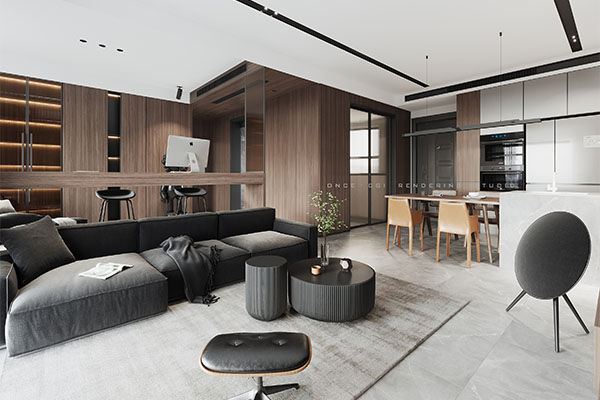
Achieving a seamless look with minimal gaps is best accomplished using a high-quality Dry Back LVT system. Gaps in commercial flooring trap unsightly debris and ruin the visual flow of a professional interior design. These crevices create unhygienic environments and make your expensive renovation look poorly installed and aging. By choosing a permanent glue-down application, you ensure a flush finish that resists shifting and maintains structural integrity for years.

Why is Dry Back LVT the best for gap-free floors?
Dry Back LVT provides a gap-free finish because the planks are permanently bonded to the subfloor, preventing any horizontal movement. This installation method eliminates the risk of “plank walking” common in floating floors. You gain a surface that feels like a single, continuous sheet of material.
The power of permanent bonding
But that’s not all. A permanent adhesive bond ensures that each plank stays exactly where it was placed during the initial installation.
- Rigid adhesion to the substrate.
- Resistance to heavy rolling loads.
- Zero horizontal shifting over time.
Precision manufactured edges
Here is the kicker: high-end manufacturing ensures that the edges of the planks meet with microscopic precision.
- Tight manufacturing tolerances.
- Squared edges for flush fitting.
- Consistent thickness across pallets.
Key Takeaway: Permanent bonding combined with precision-cut edges creates a monolithic surface that resists the formation of gaps even under heavy commercial use.
| Feature | Dry Back LVT | Floating Floors | |
|---|---|---|---|
| Bond Type | Permanent Adhesive | Mechanical Click | |
| Gap Resistance | High | Moderate | |
| Movement | Static | Expands/Contracts |
Guidance: Prioritize squared-edge planks if your goal is a completely flat, seamless aesthetic across large floor plates.
How does thermal stability prevent expansion gaps?
Thermal stability in Dry Back LVT is achieved through a multi-layered construction that resists shrinkage and expansion. Unlike natural wood, this synthetic material is designed to handle fluctuating temperatures without pulling apart at the seams. You can rely on its dimensional stability in various climate conditions.
Role of the PVC core
You might be wondering why the core matters so much for gaps. The flexible PVC core is engineered to distribute tension across the entire floor rather than concentrating it at the joints.
- Flexible core composition.
- Heat resistance properties.
- Stress distribution.
Impact of UV coatings
It gets even better when you consider the protective top layers. High-quality coatings prevent the core from absorbing too much solar heat, which can lead to material softening.
- Solar heat protection.
- Surface integrity maintenance.
- Color fastness.
Key Takeaway: A stable core and protective UV layers work together to ensure the planks do not change size, keeping the seams tight and invisible.
| Stability Factor | Benefit | Result | |
|---|---|---|---|
| Multi-layer PVC | Resists shrinkage | Tight seams | |
| UV Coating | Blocks solar heat | Prevents warping | |
| Adhesive Bond | Locks dimensions | No gapping |
Guidance: Ensure the material is stored in a climate-controlled environment to maintain its factory dimensions before the glue sets.
Why is subfloor prep critical for seamless looks?
Proper subfloor preparation ensures Dry Back LVT lies perfectly flat, which is the foundational requirement for a gap-free installation. Any high spots or dips in the substrate will cause the planks to angle away from each other, creating visible lines. You must achieve a “sanding-smooth” finish before applying any adhesive.
Leveling the substrate
Let’s be honest: a floor is only as good as what is underneath it. Using a self-leveling compound is the most effective way to eliminate the “waves” that cause seam separation.
- Sanding high spots.
- Filling cracks and voids.
- Self-leveling application.
Managing moisture levels
Here is the truth about moisture and gapping. If the subfloor is damp, the adhesive will fail, causing the corners of the planks to lift and create gaps.
- RH (Relative Humidity) testing.
- Moisture barrier installation.
- Bond integrity verification.
Key Takeaway: A perfectly level and dry subfloor prevents “telegraphing” and adhesive failure, both of which are primary causes of floor gaps.
| Prep Step | Tool/Material | Objective | |
|---|---|---|---|
| Leveling | Leveling Compound | Remove dips | |
| Sanding | Floor Grinder | Remove peaks | |
| Drying | Moisture Meter | Ensure bond |
Guidance: Invest more time in the substrate preparation phase to save on long-term maintenance and gap repairs later.
Which adhesive techniques ensure long-term stability?
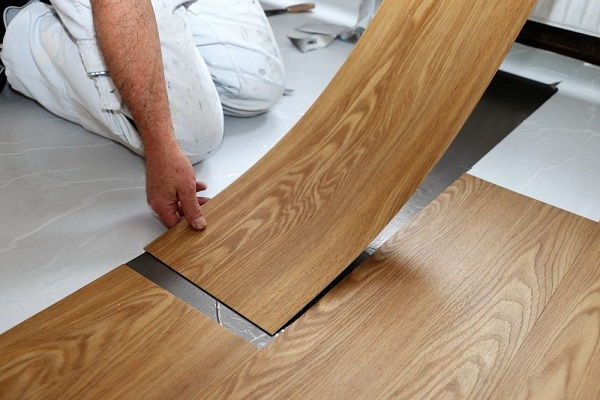
Using the correct adhesive and trowel notch is vital for securing Dry Back LVT so it never pulls away from the seams. The choice between pressure-sensitive and hard-set glues depends on your specific traffic requirements. You need a bond that creates a rigid horizontal lock.
Choosing hard-set adhesives
You see, hard-set adhesives are the gold standard for high-traffic commercial zones. Once cured, they become incredibly rigid, making it physically impossible for the planks to shift.
- Rigid chemical bond.
- Horizontal locking force.
- High-traffic durability.
The importance of rolling
But wait, there’s more to the process than just laying the planks. You must use a 100lb roller to press the material into the glue, ensuring every square inch makes contact.
- 100lb roller usage.
- Air pocket removal.
- Maximum adhesive transfer.
Key Takeaway: Correct adhesive selection and heavy rolling are the final steps in locking the planks into a permanent, gap-free position.
| Technique | Requirement | Benefit | |
|---|---|---|---|
| Glue Selection | Hard-set Adhesive | No plank movement | |
| Trowel Work | Fine-notch Trowel | Even glue spread | |
| Rolling | 100lb Floor Roller | 100% Surface contact |
Guidance: Always follow the adhesive manufacturer’s “open time” instructions to ensure the planks don’t slide after being set.
Can you get the same result with SPC flooring?
You generally cannot achieve the same permanent flushness with SPC as you can with Dry Back LVT because SPC is a floating system. While SPC is incredibly stable and waterproof, it requires expansion gaps at the perimeter to function correctly. This often results in a floor that looks less “integrated” into the building structure.
Expansion gap requirements
Here is the catch with floating installations. Because the entire floor moves as one unit, you must leave space at the walls, which often requires baseboards or moldings to hide.
- Perimeter expansion gaps.
- Transition moldings.
- Seasonal floating movement.
Subfloor imperfection bridging
On the other hand, SPC is excellent if your subfloor is less than perfect. Its rigid limestone core can bridge minor dips that would cause glue-down planks to sink and show gaps.
- Rigid core stability.
- Telegraphing resistance.
- Rapid installation speed.
Key Takeaway: SPC is a faster solution for imperfect floors, but it cannot match the seamless, edge-to-edge integration of a professionally glued Dry Back system.
| Feature | Dry Back LVT | SPC Click | |
|---|---|---|---|
| Seam Look | Flush/Seamless | Mechanical Joint | |
| Edge Gaps | Not Required | 1/4 inch Required | |
| Aesthetic | Fixed/Integrated | Floating/Detached |
Guidance: Choose SPC for speed and uneven subfloors, but stick to Dry Back for a high-end, monolithic architectural look.
Is Dry Back LVT better for large open spaces?
Large spaces benefit more from Dry Back LVT because the glue prevents the cumulative shifting that often plagues floating floors. In massive office floorplates, the weight of furniture can pin a floating floor down, causing tension to build until a seam pops open. You avoid this risk entirely with a full-spread adhesive application.
Eliminating the bounce
Think about this: a glued floor feels like a structural part of the building. It eliminates the hollow “clacking” sound and the slight vertical bounce found in click-lock systems.
- Solid underfoot feel.
- Sound dampening.
- No hollow noise.
Ease of local repair
That’s not all; repairing a single plank in a large room is much simpler. You can heat up the adhesive, pull the damaged piece, and drop a new one in without disturbing the rest of the floor.
- Individual plank replacement.
- No need to lift rows.
- Minimal facility downtime.
Key Takeaway: For large-scale commercial projects, the structural stability and ease of local repair make glue-down systems the most reliable long-term choice.
| Project Size | Recommended Type | Reason | |
|---|---|---|---|
| Small Office | SPC Click | Fast & Easy | |
| Large Lobby | Dry Back LVT | No shifting risk | |
| High Traffic | Dry Back LVT | Repairability |
Guidance: For spaces over 1,000 square feet, always consider the long-term stability of a glue-down system over a floating one.
How do you handle gapping in high-sunlight areas?
Managing gaps in sunny areas requires using high-temperature adhesives and proper acclimatization of the Dry Back LVT planks. Direct sunlight through large windows can cause synthetic materials to expand rapidly during the day and contract at night. You must prepare for these thermal cycles to keep your seams tight.
Acclimatization protocols
This is key to success: you must let the flooring sit in the target room for at least 48 hours. This allows the material to reach the ambient temperature and humidity where it will be permanently installed.
- 48-hour window.
- Ambient temperature matching.
- Humidity balance.
Specialized solar adhesives
The secret is this: use an adhesive specifically formulated for high-heat environments. These glues do not soften when the sun hits the floor, keeping the planks locked in their original position.
- Heat resistance.
- Non-softening formula.
- UV-stable bonding.
Key Takeaway: Successful installation in sunny areas depends on material acclimatization and the use of heat-stable adhesives to prevent thermal gapping.
| Sun Factor | Problem | Solution | |
|---|---|---|---|
| Solar Gain | Material Expansion | Solar Adhesive | |
| Temperature Drop | Material Contraction | Acclimatization | |
| UV Exposure | Surface Fading | UV Coating |
Guidance: Install blinds or temporary window films during the installation process to prevent extreme temperature spikes while the glue is curing.
What design patterns hide seams most effectively?
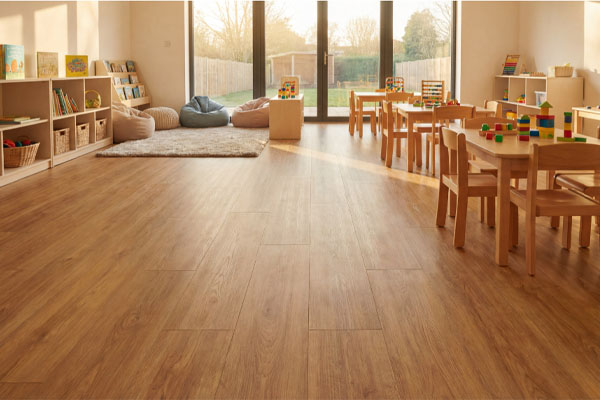
Certain patterns like herringbone or stone textures used with Dry Back LVT naturally mask the appearance of transitions. By breaking up long, straight sightlines, you make it much harder for the eye to detect where one plank ends and another begins. You can use geometry to your advantage to achieve that “single-sheet” illusion.
The herringbone advantage
You will notice that staggered patterns like herringbone naturally hide gaps. Because the joints meet at various angles, the light hits the floor differently, making microscopic seams disappear.
- Broken sightlines.
- Visual distraction.
- Premium aesthetic.
Stone and marble effects
Here is the kicker: choosing large format stone or marble designs can create a monolithic look. When these are glued down with tight seams, the floor looks like poured concrete or solid stone slabs.
- Large format tiles.
- Monolithic appearance.
- Grout-free beauty.
Key Takeaway: Smart design choices like herringbone patterns or stone textures can visually erase the seams, enhancing the overall seamless effect.
| Pattern Style | Visual Effect | Best For | |
|---|---|---|---|
| Herringbone | Dynamic/Broken lines | High-end Offices | |
| Stone/Concrete | Solid/Monolithic | Lobbies/Retail | |
| Wide Plank | Spacious/Classic | Residential/Multi-family |
Guidance: Use a pattern that runs perpendicular to the main light source to further minimize the visibility of plank joints.
Why does wear layer thickness protect the seams?
A thick wear layer on Dry Back LVT prevents the edges of the planks from curling or chipping under heavy rolling loads. When the edges of a plank become damaged, it creates a visual gap even if the planks haven’t physically moved. You need a robust protective layer to maintain that clean, flush edge for the life of the floor.
Commercial grade protection
You should know that a 0.5mm wear layer is the industry standard for professional spaces. It provides enough thickness to resist the scuffing and impact that typically happens at the plank joints.
- 0.5mm commercial standard.
- Scratch resistance.
- Edge integrity.
UV coating maintenance
Best of all, a high-quality UV coating makes the floor much easier to maintain without damaging the seams. Because the joints are so tight, you don’t have to worry about cleaning liquids seeping in and attacking the glue.
- Easy damp mopping.
- Stain resistance.
- Long-term surface clarity.
Key Takeaway: A heavy-duty wear layer ensures that the edges of your planks remain sharp and flush, preventing “visual gapping” caused by wear and tear.
| Wear Layer | Traffic Level | Estimated Life | |
|---|---|---|---|
| 0.3mm | Light Residential | 10-15 Years | |
| 0.5mm | Heavy Commercial | 20+ Years | |
| 0.7mm | Industrial/Extreme | 25+ Years |
Guidance: Always specify at least a 0.5mm wear layer for commercial projects to ensure the seam integrity remains intact under foot traffic.
Why buy directly from a flooring manufacturer?
Partnering with a factory for your Dry Back LVT ensures batch consistency, which is essential for a perfect, gap-free fit. Even a 0.1mm difference in plank width between different production batches can lead to noticeable gaps over a large area. You eliminate this risk by sourcing your entire project from a single production run.
Eliminating batch variation
Trust me on this: buying through middlemen often leads to mixed batches from different production dates. Sourcing directly ensures that every plank has the exact same dimensions and locking tolerances.
- Single production runs.
- Exact width precision.
- Consistent color matching.
Technical project support
Finally, working with a manufacturer gives you access to expert guidance that retailers can’t provide. They can recommend the exact wear layer and adhesive combination for your specific building conditions.
- Custom specifications.
- OEM branding options.
- Direct technical support.
Key Takeaway: Factory-direct sourcing is the most reliable way to ensure dimensional consistency and technical accuracy for a successful, gap-free installation.
| Sourcing Method | Dimensional Risk | Expert Support | |
|---|---|---|---|
| Retailer | High (Mixed batches) | General | |
| Wholesaler | Moderate | Sales-focused | |
| Manufacturer | Zero (Single run) | Technical/Deep |
Guidance: Request a single-batch guarantee for your project to ensure the highest possible level of seam precision.
Summary: Achieving the Perfect Finish
Achieving a truly seamless, professional floor requires a combination of high-quality materials, meticulous subfloor preparation, and precision installation techniques. By focusing on the permanent stability of glue-down systems and sourcing directly from a trusted manufacturer, you can eliminate the problems of gapping and shifting that often plague commercial interiors. Our vision is to provide durable, aesthetic flooring solutions that stand the test of time and traffic. If you are ready to solve your flooring challenges with precision-engineered products, contact us today to request samples or a customized quote for your next project.
FAQ
Can I install Dry Back LVT over existing ceramic tile?Yes, but only if you fill the grout lines with a high-quality skim coat first. Any unevenness in the underlying tile will eventually show through the vinyl, ruining the seamless look.
What’s the best way to clean a gap-free LVT floor?A simple damp mop with a pH-neutral cleaner is best. Because the seams are so tight, dirt cannot hide in the joints, making the floor significantly more hygienic than traditional options.
How do I know if my subfloor is dry enough for glue?You must perform a Calcium Chloride or RH test. If moisture levels are too high, the adhesive will not cure correctly, leading to corner lifting and unsightly gaps.
Can I use Dry Back LVT in a bathroom or wet area?Absolutely. Because it is made of 100% waterproof PVC and permanently glued down, it is an excellent choice for areas prone to moisture and frequent cleaning.
Can I install this product myself for a commercial project?For a professional, gap-free result, we strongly recommend a certified installer. The precision required for glue-spreading and plank-fitting is very high in a B2B environment.